
The wayleave platform built for UK telecoms
Purpose-built for the way telecoms wayleave agreements actually work, from Code operator rights to RAMS compliance, from Openreach to altnets.
The UK's full-fibre rollout depends on wayleaves
The government’s gigabit target depends on efficient wayleave processing to connect multi-tenanted buildings across the UK. New dwellings in England must be built with gigabit-ready physical infrastructure and, where reasonable, a gigabit connection, which leaves the buildings already standing as the work.
Every multi-tenanted building needs at least one wayleave agreement for broadband connectivity.
The route exists. The reason you need it does not have to.
The route that exists
Where a landlord repeatedly fails to respond, the 2021 Act gives you a tribunal.
A last resort
You keep the right. Using it means a tribunal and a landlord you will work with again.
What Wayline does instead
Landlords do not respond because responding is unpaid administration.
So Wayline pays them
The landlord sets the fee and is paid when the agreement completes. Responding stops being unpaid work.
Which buildings the route reaches
- Blocks of flats · covered
- Apartment buildings · covered
- Business parks · consulted on, 2021
- Office blocks · consulted on, 2021
- Retail, industrial · not covered
How Wayline handles telecoms wayleaves
Code and non-Code operator handling
Wayline’s agreement templates account for both Code operator statutory rights and non-Code contractual arrangements.
14-category RAMS AI review
Our AI reviews telecoms RAMS documents against 14 risk categories specific to building installations: working at height, asbestos, fire safety, electrical safety, and more.
Standard wayleave agreement templates
Based on industry-standard terms, customised per building’s preferences. Covers equipment installation, maintenance access, reinstatement obligations, and termination provisions.
Insurance verification
Public liability and employers’ liability certificates checked automatically. Coverage amounts verified against building minimums.
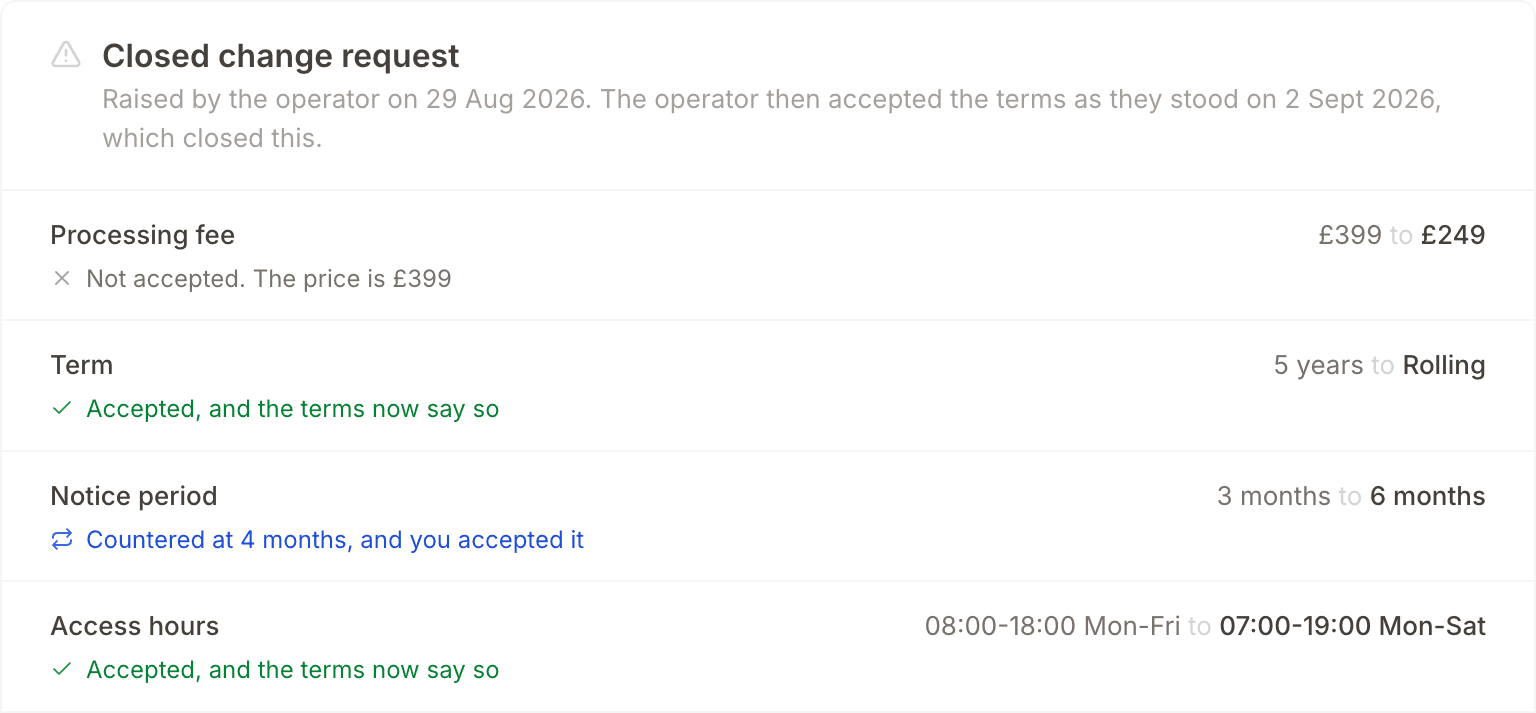
Term-by-term negotiation
A landlord who disagrees with one term does not have to reject the request. Each term is accepted, rejected or countered on its own, and a counter can be accepted in turn, so a negotiation is a list of settled items rather than a new draft each time.
When the request closes, what happened to every term is on the record beside the agreement it produced.
Who it's for
Altnets
G.Network, Community Fibre, Hyperoptic, etc.
Scaling FTTP rollouts across urban MDUs. Need efficient wayleave processing to hit rollout targets.
Major operators
Openreach, Virgin Media O2
Managing wayleave portfolios across thousands of buildings. Need standardisation and compliance.
Wireless operators
MNOs, neutral hosts
Installing small cells, DAS, and 5G infrastructure in buildings. Similar access requirements, different installation types.
The agreement is not the risk. Year five is.
An access agreement is signed once and lives for its term. What goes wrong is rarely the negotiation; it is a renewal date nobody diarised, an insurance certificate that expired two years ago, as-built drawings that were never filed, and a reinstatement obligation nobody can now describe. By the time any of it surfaces, your equipment is already in the building and the conversation is with a landlord who has lost confidence in you.
Renewal
The date, and notice before it, held against the agreement rather than in a calendar somebody left with.
As-built evidence
What you actually installed, filed where the landlord can see it, so year five is not an argument about scope.
Insurance
Cover checked at submission and tracked afterwards. An expired certificate is a lapse whether or not anyone notices.
Reinstatement
The scope you agreed to and its completion, recorded, so leaving the building is a task rather than a dispute.
Wayline holds all of it against the agreement. Renewal dates, as-built evidence, current cover, and the reinstatement scope you agreed to, from signature to the end of the term.
Free for operators, permanently
Search buildings, submit requests, upload RAMS, negotiate terms and sign. You pay the landlord's processing fee when an agreement completes, and nothing else.