
Wayleave management for your entire portfolio
Standardise terms across every building. Track every agreement. Generate processing fee revenue for your clients. Wayline replaces the spreadsheets, solicitors, and endless email chains.
Managing wayleaves at scale is broken
You manage 20, 50, maybe 200 buildings. Each one gets wayleave requests from different operators, with different terms, at unpredictable times. There's no standard process. Terms vary building to building. Solicitor fees eat into your clients' budgets. Agreements expire without anyone noticing.
Professionalise the process, and create a revenue stream for your clients
The first building is free, so nothing has to pay for itself until the second. After that, at a processing fee of £299 per wayleave, your client receives £239.20 once the agreement completes. That is recurring revenue that did not exist before, generated by a process you were already handling, just without the tools.
Portfolio economics
- Wayleaves a year
- 20 buildings × 2 = 40
- Your client receives, each
- £239.20 of a £299 fee
- Portfolio tier, paid by you
- £4,990 a year, unlimited buildings
- Revenue to your clients
- £9,568
A year, across the portfolio
The Portfolio subscription is paid by your organisation and processing fee revenue belongs to the building owner, so the two do not net against each other. Recharging a management cost of this kind to clients through the individual buildings' service charges is an accepted route and one this fits, though whether it is open to you depends on your own management agreements.
Buildings commonly see one to three wayleave requests a year. Two per building, and the recharge route above, are assumptions drawn from experience of this market, not figures measured on the platform, and your portfolio will differ.
Built for the way wayleaves actually work
Portfolio-wide preferences
Set default wayleave terms across your entire portfolio. Individual buildings can override where needed. One policy, managed centrally.
A recommendation report you can send upwards
Two pages, printable and signable, capturing the request facts and your own sign-off recommendation. Where the authority to approve sits with a client or an asset manager, this is the artefact that goes to them. It is produced as a PDF and its generation is recorded in the audit log.
Free onboarding on annual plans
Annual Portfolio and Enterprise customers send us the wayleave agreements they already hold, and we digitise them: structuring the terms, recording expiry dates, and putting the whole portfolio somewhere it can be seen at once.
Compliance without complexity
Every RAMS reviewed automatically. Every agreement version-tracked. And an operator without current public liability and employers liability cover cannot submit at all: the platform refuses it.
Revenue generation, not just cost management
Processing fees are standard in the industry but rarely enforced because the admin is too heavy. Wayline automates collection: your clients earn, you deliver value.
The Grantor configuration
Specify whether the freeholder or your organisation is named as Grantor on wayleave agreements. Wayline handles the legal entity configuration so agreements are always correctly structured.
Superior landlord consent, recorded
Where a head lease requires the superior landlord's consent, that consent is recorded against the agreement, and the agreement cannot proceed to signature without it.
A record you can produce on demand
Every renewal, notice, reinstatement and as-built photograph, against the building it belongs to, for the whole term rather than up to signature. When a client asks what is in their building, the answer is one view rather than a search.
Information guides under your own brand
Guides for operators and for tenants, generated per building. Hand a letting agent or a prospective tenant a clear account of what connectivity the building has and how access works.
Multi-building dashboard
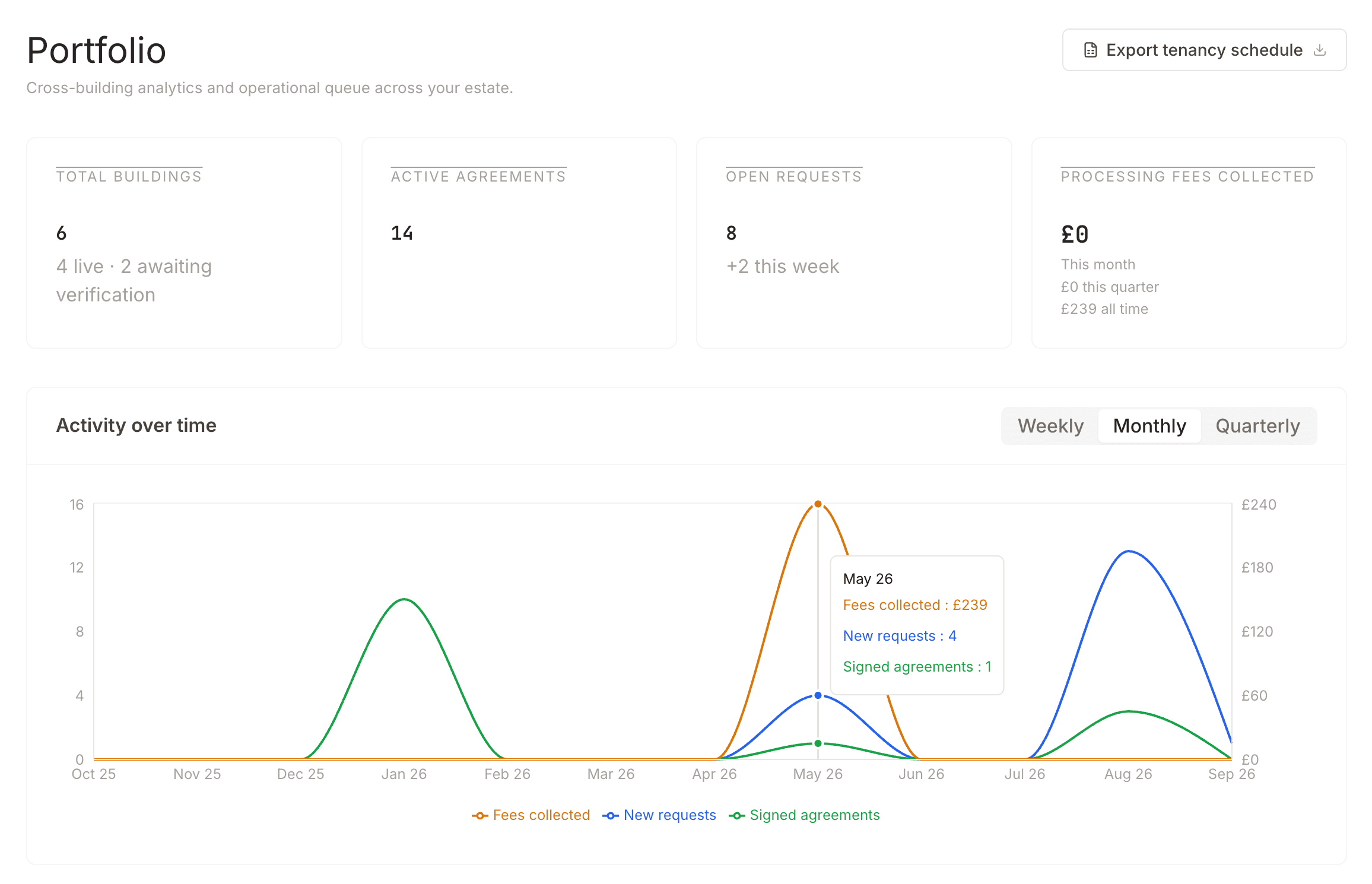
See every request, agreement, and expiry across your portfolio in one view. No more building-by-building checking.
How a portfolio comes onto Wayline
- 1
Send us your agreements
The wayleave agreements you already hold, in whatever state they are in.
- 2
We digitise them
Structuring the terms, recording expiry dates, and putting the whole portfolio somewhere it can be seen at once.
- 3
Set defaults once
Notice periods, processing fees, insurance minimums and access hours, across the estate rather than building by building.
- 4
Buildings inherit
Every building takes the portfolio defaults, and any building can override where its own circumstances differ.
- 5
Requests arrive against your rules
Each contested term is accepted, rejected or countered on its own, and nothing reaches signature with an item unanswered.
- 6
Everything visible in one view
Every request, agreement and expiry across the portfolio, with a tenancy schedule you can export.
The law already changed, and most landlords missed it
The Telecommunications Infrastructure (Leasehold Property) Act 2021 received royal assent on 15 March 2021 and is in force. It inserted Part 4A into the Electronic Communications Code and gives an operator a tribunal route into a multi-dwelling building where a tenant has requested service and the landlord has repeatedly failed to respond.
Up to 40%
of operator access requests get no response, according to the government’s own review. Being the landowner who does respond has stopped being a courtesy.
Which buildings the Act reaches
- Blocks of flats · covered
- Apartment buildings · covered
- Business parks · consulted on, 2021
- Office blocks · consulted on, 2021
- Retail, industrial · not covered
Returns you can show your clients
You can tell a client you created capital value where there was none. At a 5 per cent yield, £1,000 a year of wayleave income represents £20,000 against the building, and across thirty buildings that is a material addition from a stream nobody was collecting.
An agreement with two years to run does not value as perpetuity income.
Start with one building, free
No card, no time limit, and the full platform. Add your building, set your terms, and take your first request through to a signed agreement.