
A wayleave does not end when it is signed
Most of an agreement's life happens after the signature. Wayline is built for all of it: the request, the negotiation, the five or ten years the equipment sits in your building, and the day it comes out.
Ask most people how a wayleave works and you get three steps.
An operator asks, a landlord agrees, both sides sign.
asks
agrees
signs
That is the easy part, and it is roughly a tenth of the story.
The agreement then sits somewhere for five years.
Insurance lapses and nobody notices.
The engineer who installed it leaves, and no record survives of what went in.
The expiry date passes.
Eventually somebody sells the building, and a solicitor asks what infrastructure agreements are in place, and the honest answer is that nobody is sure.
Wayline runs the whole thing.
See the seven stagesThe seven stages
Request
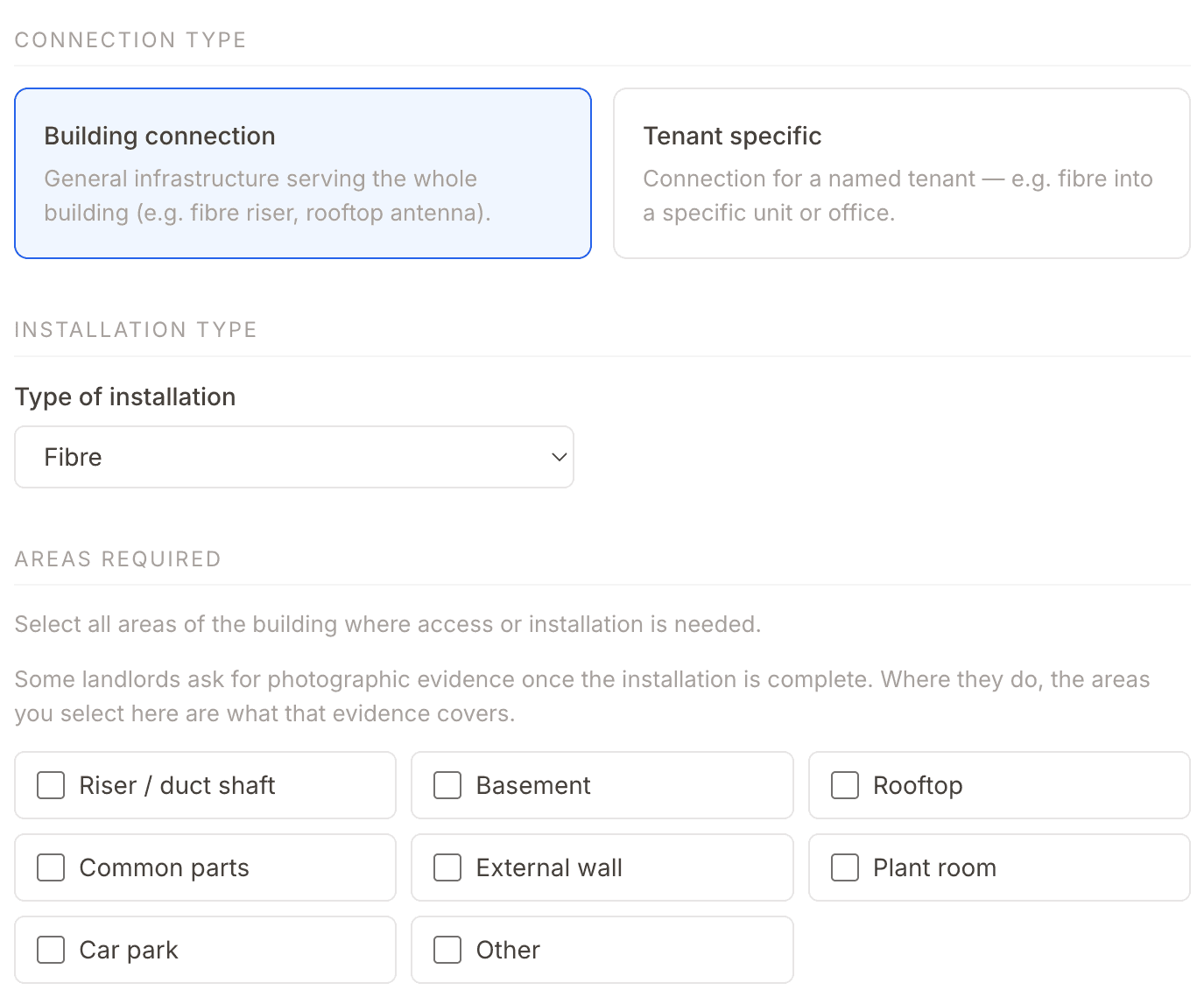
An operator submits
The operator finds the building, describes the installation and attaches their RAMS.
Public liability and employers liability cover is checked before the request can be sent at all. Not flagged afterwards, not chased: an operator without current cover cannot submit. That single rule removes the most common way a landlord ends up exposed.
Operator's move.
Review
You review, with the reading done for you
The RAMS is assessed automatically against 14 safety categories, so what reaches you is a risk summary rather than a 30-page method statement you do not have time for. If something in it deserves a second opinion, you can commission a human expert review for £99.
The operator's Code status is established, so you know whether you are dealing with statutory rights under the Electronic Communications Code or a purely contractual arrangement.
Where a head lease requires superior landlord consent, it is recorded before anything progresses.
And if the decision is not yours to make, which for a managing agent it usually is not, Wayline produces a two-page recommendation report capturing the request and your recommendation. Print it, sign it, send it to whoever holds the authority.
Your move.
Terms
Your terms, applied automatically
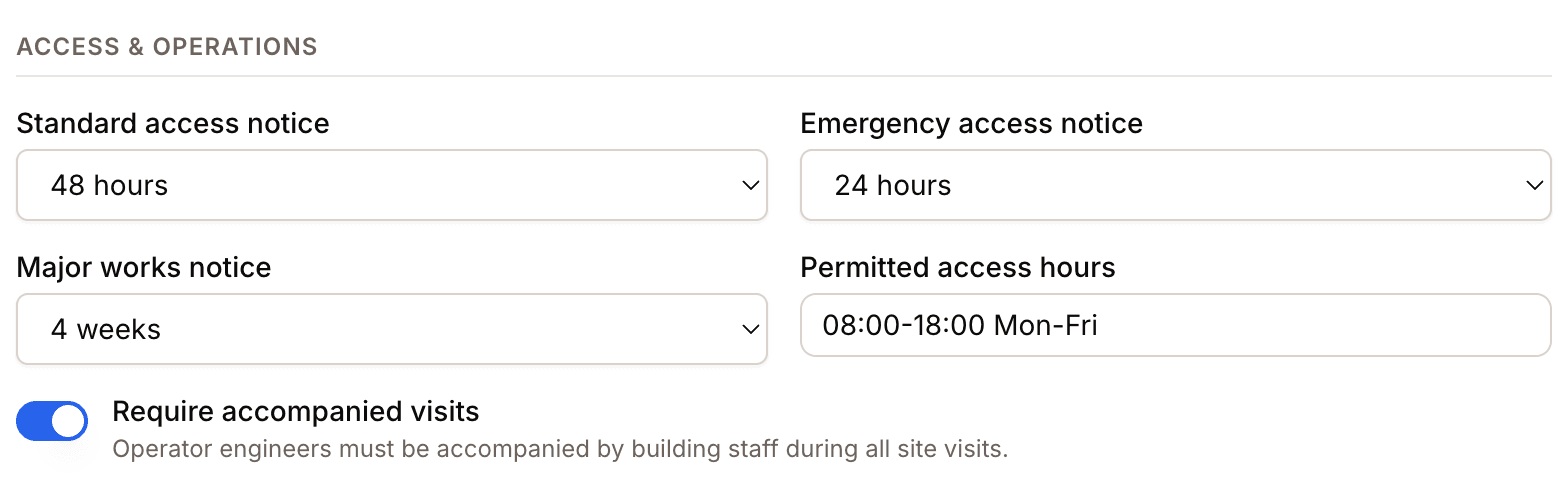
Terms come from the preferences you set once on the building: processing fee, term length, notice period, access hours, reinstatement obligations. The agreement is drafted from them.
You set the rules once. Every operator who comes to that building meets the same ones.
Your move.
Negotiation
Disagreements handled item by item
This is where most processes fall apart, because a change request arrives as a paragraph of prose and somebody has to translate it into a document by hand.
On Wayline an operator contests individual terms. You respond to each one: accept it, reject it with a reason, or counter with a different value. Accepted changes are written straight into the agreement rather than retyped.
Nothing reaches signature while an item is unanswered. You cannot accidentally sign an agreement somebody formally objected to.
Both.
Signature
Signed, and paid
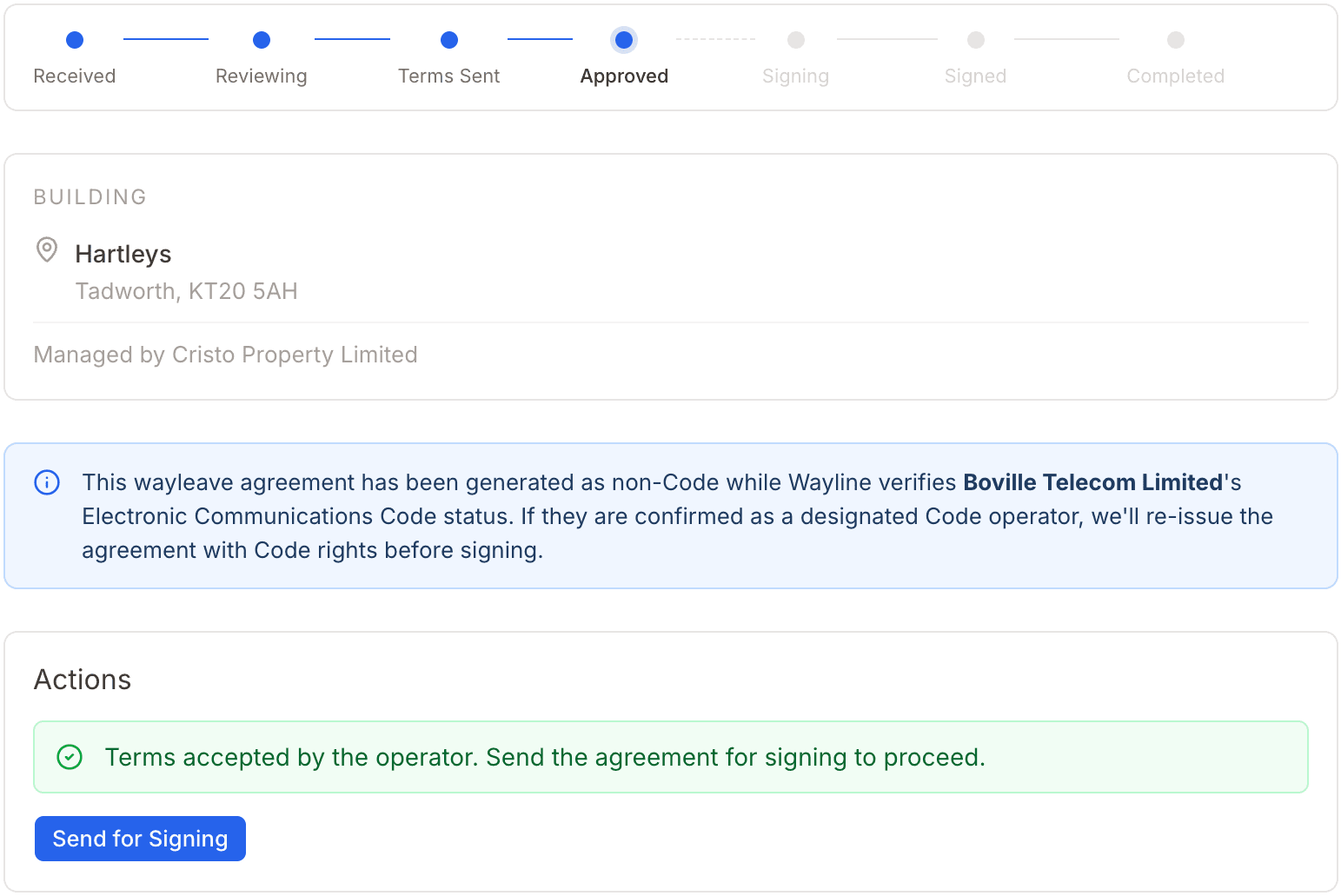
Both parties sign digitally. The processing fee is collected from the operator and split automatically: 80 per cent to you, direct to your bank.
Both.
In force
Tracked for the whole term
This is the stage nothing else covers.
The operator uploads photographic as-built evidence of what was actually installed and where, and you accept it, dispute it, or ask for changes. In five years, when somebody asks what is in the riser, there is an answer.
Insurance expiry is watched and warned on. Renewal dates surface before they arrive rather than after.
Every version of the agreement is retained, with the reason that version exists. Not just what was agreed, but why it changed.
Both.
Conclusion
Renew, or let it lapse
Renewal generates a successor agreement and shows you what has changed against the original, so you are not reading two documents side by side looking for differences. Where an agreement is ending, reinstatement is a process rather than a hope: you issue a scope of works, the operator acknowledges it, submits the completed works, and you verify or dispute them. A completion certificate closes it out.
The most expensive wayleave is the one nobody is tracking. An operator in your building on expired terms, with no valid insurance and no enforceable obligation to put anything back. Stage 7 is how that stops happening.
- Renew
- Let it lapse
Your move.
Both sides, one record
Wayline is not a landlord tool that operators tolerate.
Free for operators
Operators use it free, permanently, and they get something they want: a landlord who responds, terms visible before they commit, and no solicitor on either side.
Minutes, not months
Give the landlord a process that takes minutes and pays them for their time, and the operator gets their answer in days.
One record, both sides
Both parties see the same record throughout: the same terms, the same version history, the same as-built evidence. Nothing is one side's word against the other's.
The reason wayleaves take months is rarely the agreement itself. It is that landlords see them as an unpaid administrative burden and put them at the bottom of the pile.
What you can prove afterwards
Everything above produces a record, and the record is worth as much as the process.
For every building: which operators have equipment in it, on what terms, expiring when, with what insurance, installed where, and what happens when it comes out.
Building record
every building, every operator
That matters at three moments.
At renewal
At sale or refinancing
At a management contract pitch
Start with one building, free
No card, no time limit, and the full platform. Add your building, set your terms, and take your first request through to a signed agreement.